


It's Sunday night and you need a video for this week. You look at what other agents posted, and you make one more tour or one more market update. It does fine, or it doesn't. Next week the page is blank again. I scored 3,726 videos from the 100 most-watched US real estate channels on YouTube to see which kinds work. The short answer: one kind clearly wins, and your viewers will tell you the rest.
Start with one video. A broker made a list of old home features that should come back: pocket doors, the laundry chute, the Dutch door. A simple idea. No drone, no mansion.
Mac Rogers - Real Estate Broker, "20 Forgotten Home Features That Need To Make A Comeback": 848,286 views. A plain list video that got 103 times the channel's usual views.
It got 848,286 views. That's 103 times what a typical video on that channel gets. And it isn't luck.
Every channel has a "usual": the views its middle video gets. I call a video a winner when it gets at least 1.5 times that. Across all the videos, 30% are winners. Videos about home features and prep tips (what to fix, what to skip, what owners regret) were winners 52% of the time, and losers only 18%. That's 82 videos on 22 channels. They beat the channel's other videos on 6 channels and fell behind on none.
The other hits look the same. Daniel Hale's "10 Forgotten Home Features We NEED To Bring Back" got 17.2 times its channel's usual. Jackie Baker's "10 WORST Home Upgrades You'll REGRET" got 16.3 times. Yet the company channels (brokerages, teams, builders) almost never make this type. I found 3 in their 488 scored long videos.
Then read the comments under the Mac Rogers video. People argue about their own homes. They talk about the house they grew up in. And one of them asks for the next video:
"I feel like you should also cover bringing back old-school kitchens."
That's a viewer writing your next title for you.
Most types land near average
Here's what makes the choice so hard. Apart from that one type, most real estate videos do about the same.
"Living in" videos: 34% winners, 30% losers.
Buyer videos: 34% winners, 31% losers.
Luxury home tours: 31% winners, 28% losers.
Seller videos: 34% winners, 37% losers.
Market updates: 29% winners, 35% losers.
All close to the 3 in 10 that any video gets. A few types do clearly worse. Personal vlogs won 13% of the time and lost 47%.
The problem isn't skill. It's having no way to choose. When you pick from what other agents post, you pick from the middle. And one video's views teach you very little, because most types land near average either way.
Why it happens: you pick from your side of the desk
It's natural to pick the next video from your own week. A new listing, so a tour. New numbers, so a market update. It's what's in front of you.
Viewers pick from a worry. A home is the biggest thing most people own, so a video that says "don't make this mistake with it" feels urgent. My read: that's why the home-feature video travels so far.
Each type that works answers one worry:
Home features and prep tips. What will cost me money? What is a mistake?
"Living in" and "moving to". Will I regret moving there?
Seller videos. Am I leaving money on the table?
Market updates. Is my timing wrong?
A tour has no worry behind it. People admire the house and move on. My read: that's why tours land right at average.
The words show the gap. In 20,581 comments, viewers almost never wrote "market update". "Relocation guide" and "neighborhood guide" barely show up at all. Those are agent words. Viewers write "HOA", "taxes", "moving" and "first home".
And the best place to find ideas is one most agents skip: the comments. I counted 393 comments that ask for a video, on 59 channels. That's 2% of all comments. Each one is a person who already watches you, telling you what they want next.
Below: the full scoreboard, why a big video and a client video are often two different videos, ten ideas you can use, a shape for a home-feature video, a monthly mix, and what to do this week.
The full scoreboard
Every type of video with enough examples to judge, best to worst. "Typical result" is how the middle video of that type did against its channel's usual. 1.00 means exactly usual.
Home features and prep tips: Winners: 52%; Losers: 18%; Typical result: 1.59
Moving to a town: Winners: 31%; Losers: 29%; Typical result: 1.06
Living in X, pros and cons: Winners: 34%; Losers: 30%; Typical result: 1.03
Buyer education: Winners: 34%; Losers: 31%; Typical result: 1.02
Luxury home tour: Winners: 31%; Losers: 28%; Typical result: 1.00
Cost of living (in the title): Winners: 25%; Losers: 28%; Typical result: 0.99
Single home tour: Winners: 24%; Losers: 29%; Typical result: 0.97
Seller education: Winners: 34%; Losers: 37%; Typical result: 0.97
Area or neighborhood tour: Winners: 29%; Losers: 32%; Typical result: 0.95
Building and design: Winners: 34%; Losers: 35%; Typical result: 0.95
Market update: Winners: 29%; Losers: 35%; Typical result: 0.93
Local news, "what's coming": Winners: 31%; Losers: 44%; Typical result: 0.80
Personal vlog: Winners: 13%; Losers: 47%; Typical result: 0.77
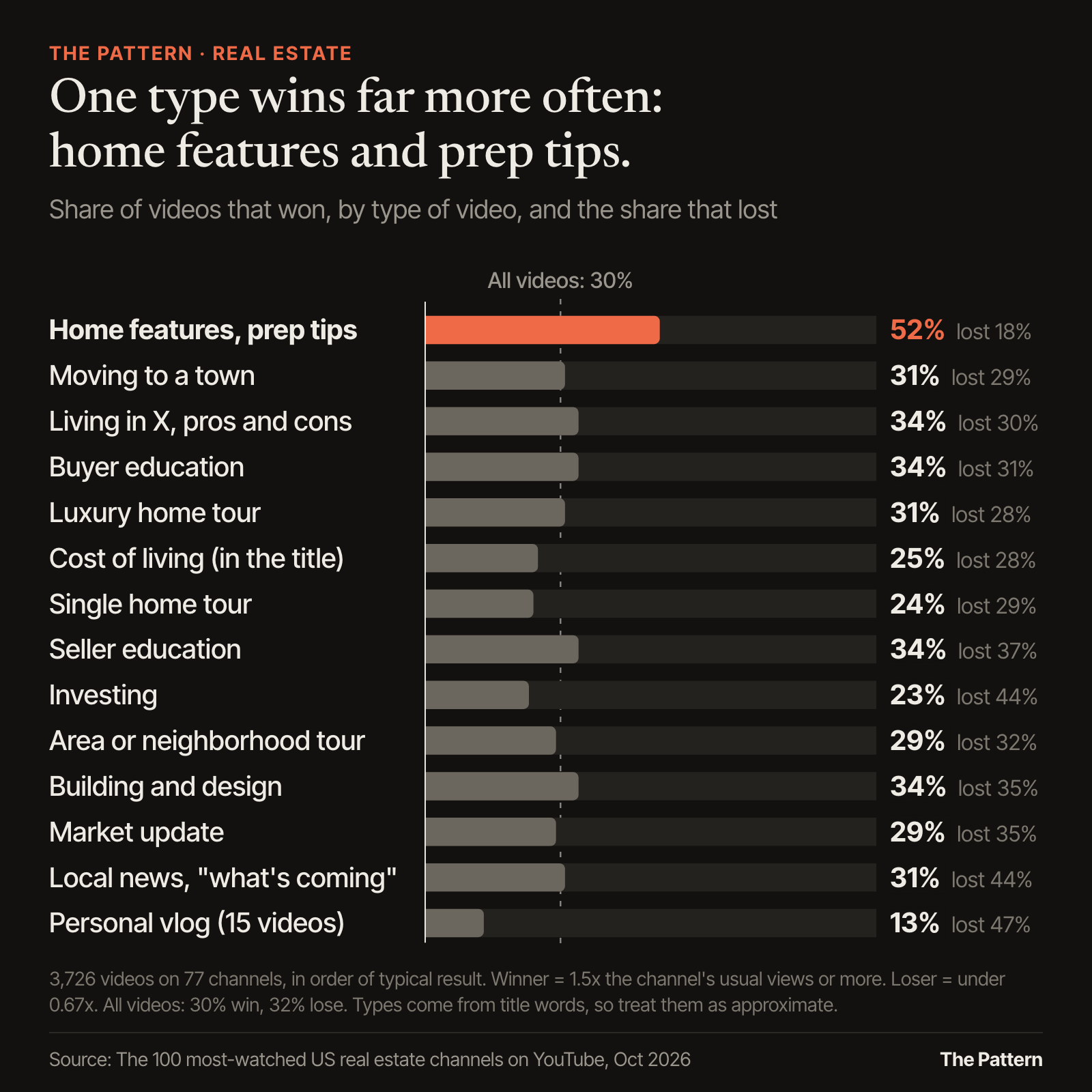
Three types lose clearly: local news lists, personal vlogs, and investing videos (23% winners, 44% losers).
For most types, the type alone rarely sinks a video. The angle and the title do a lot of the work. The title words agree with the table: "kitchen" went with 1.70 times the usual, and did better on 8 channels and worse on none. "Upgrades": 1.66 times.
Home-feature videos have one more thing going for them: everyone lives in a home, so everyone has an opinion. More than half the comments under them are opinions (54%). One viewer under the Mac Rogers video: "I'm waiting for the kitchen to come back. Open concept isn't all that great." My read: a topic people argue about is a topic people pass on.
A big video and a client video are often two different videos
The honest catch: home-feature videos bring views more than clients. They draw about 0.6 comments per 100 that sound like a future client. "Moving to" and "living in" videos draw about 3.0, seller videos 2.9, buyer videos 2.7. (The first piece in this collection explains why place videos bring the people planning a move.)
So give each video a job. A home-feature video is how new people find you. A place, buyer or seller video is where the people getting ready to move speak up. My suggestion: end every home-feature video by pointing to one client video. "If you're thinking of buying in [town], watch this one next."
Your viewers already wrote your list
Here are some of the 393 requests, word for word:
"You've made several videos about where not to buy. Please make a video about where to buy."
"Can you do a video on the decent home builders?"
"Can you please do a video on the most affordable homes/communities under 300k?"
"Please do a video on the best places in Arizona for snowbirds on a budget. Thanks!"
"Can you do a video that shows how to make your monthly payment lower?"
Each one names a place, a budget, a group of people or a worry. None asks for a market update.
Questions count too. Under "moving to" videos, 10% of the questions are some version of "what about my area?" Under local news videos, 21%. One viewer asked: "What about Holly Springs? Is that a good town as well?" That's a whole video.
And when I sorted every comment about buying and selling, the biggest theme wasn't price. It was space and layout: single-story, the garage, the yard, the open plan (1,478 comments, on 69 channels). Builder quality and hidden problems came up in 1,432, about 5 times the talk about waiting versus buying now. The house itself is full of ideas.
Ten ideas you can use
These are my ideas, built from what viewers ask. Not tested titles.
10 things buyers in [town] walk away from, and what each one costs to fix
The upgrades my [town] sellers wish they had skipped
Kitchen mistakes that cost [town] sellers money
What I check on a new build in [area] before closing day
The hidden problems I see most in [town] homes built in the [decade]s
Single-story homes in [metro]: where to find them and what they cost
Where to buy in [metro], not just where to avoid
The [area] builders I'd look at, and what to ask each one
The most affordable areas in [metro] under $[price]
The best places in [state] for retirees on a budget
1 to 5 are home-feature videos: your reach. 6 to 10 come from viewer requests and worries, and name a place: the kind of video that draws people planning a move.
A simple shape for a home-feature video
The first 15 seconds. Say the promise and give the first item right away: "Here are 10 things buyers in [town] walk away from. Number one is the one I see most." No logo, no long hello.
One item at a time. What it is, what it costs or why people regret it, what you'd do. One real example from a home you've seen.
Mix the good and the bad. Not ten complaints in a row. Put a "do this instead" item after every two or three warnings. Save a strong one for the end.
The end. Close on your best tip, then point to one place or buyer video for the people who are getting ready to move.
You already have the material. You walk through homes every week. Most viewers never do.
A simple mix for the month
My suggestion, not a rule from the data. If you post four long videos a month:
One home-feature or prep video: what to fix, what to skip, what buyers in your area regret.
One "living in" or "moving to" video about a town you serve, fair to both sides.
One buyer or seller video tied to what is changing right now.
One tour, with the price and the location in the first lines of the description.
If you post less, rotate through the four.
Mistakes to avoid
Picking from other agents' feeds. Tours are the most common long video: luxury tours are 18% of what the top 100 post, and 30% on the company channels. Copy average, get average.
Expecting a million views. "10 Horrible Home Features You'll REGRET" got 1,909,640 views on a channel whose usual video gets 1,752. An outlier. Trust the pattern across 22 channels instead.
Going short. 3 to 5 minutes was the worst length: 24% winners, 40% losers. 12 to 20 minutes did best (33% winners, 30% losers). People deciding what to fix or where to live want the whole answer.
Do this this week
Read your last 100 comments. Copy every video request and every "what about [place]?" into one list. That's your next month.
Plan your home-feature video: ten things buyers in your area walk away from, or ten upgrades your sellers wish they had skipped.
Put your next four videos on a calendar with the mix: one home-feature video, one place video, one buyer or seller video, one tour done right.
How I did this
I ranked US real estate channels by total views, starting from 1,457 channels found through 62 YouTube searches and known lists. I kept the ones run by an agent, team, brokerage, builder or relocation business, or that teach buyers and sellers, with an upload in the last 12 months. These are the 100 most-watched among the channels I found, not every channel on YouTube. I also looked at 25 company channels.
Each channel's "usual" is the middle view count of its last 30 long videos (3 to 40 minutes) from the last 12 months. 77 of the 100 channels had enough long videos to have one. That gave 3,726 scored videos. A winner got 1.5 times the usual or more, a loser under two-thirds of it. I sorted videos into types by their titles. In an earlier check, about 1 in 8 was sorted wrong, so treat the shares as "about".
I also read 20,581 comments: the 100 most relevant threads on about 800 videos, which lean toward liked comments. I sorted them with word rules, which miss sarcasm and slang. The client-style counts are comparisons between video types, not totals. I can't see watch time or anyone's private analytics. Only what's public.
Some counts in this piece (the share of opinion comments, the layout and builder comments, and the questions people ask) come from a second pass over the same channels: 20,969 comments, counted a little differently, and 969 video descriptions. So a few shares use that base instead of 20,581.
More from The Pattern
Two ways to get it done
If you want it done for you. The Green Room: a full YouTube team for your business, picked by me. They plan, film and edit. You show up and go on air. See the Green Room
If you'd rather talk first. Say hi on LinkedIn. I read everything. Connect on LinkedIn