


You film the tour. You edit it, post it, and it does well. Thousands of views. Nice comments. Then nobody calls. I read 20,581 comments under the 100 most-watched US real estate channels on YouTube to find out why. The short answer: your video picks who shows up.
Start with one video. It's a walkthrough of a modern farmhouse in Utah, and it passed 1 million views. That's a real win for any builder.
Robison Build Co., "Dreamy Modern Farmhouse in Utah": 1,082,345 views. A great tour. Its comments are almost all admiration.
So I read the comments. "Gorgeous!" "Dream house." "What a beautiful home!" Lovely to read. But almost nobody in there says they're looking for a home.
Now a plainer video: "Top 5 Reasons Why You Should NOT Move to Ocala Florida". A fraction of the views. Read the comments and the tone changes completely:
"We are moving from Middleton Tennessee and coffee county and we are considering the city of Ocala within the next 12 to 18 months. How can you help me"
Florida Living with Tammy, "Top 5 Reasons Why You Should NOT Move to Ocala Florida". Fewer views, and comments from people planning a move.
That's a future client, asking for help, in public.
Four kinds of people watch your videos
Most comments are reactions and thanks. But in 4,790 of them, people say where they are in a move. They fall into four groups:
Dreaming or browsing: 49%. "That chandelier!"
Already living there: 25%. "I've lived here 20 years..."
Planning, 6 to 24 months out: 18%. "In 2027 I'm going to buy my first home."
Moving or buying now: 8%. "I close in three weeks."
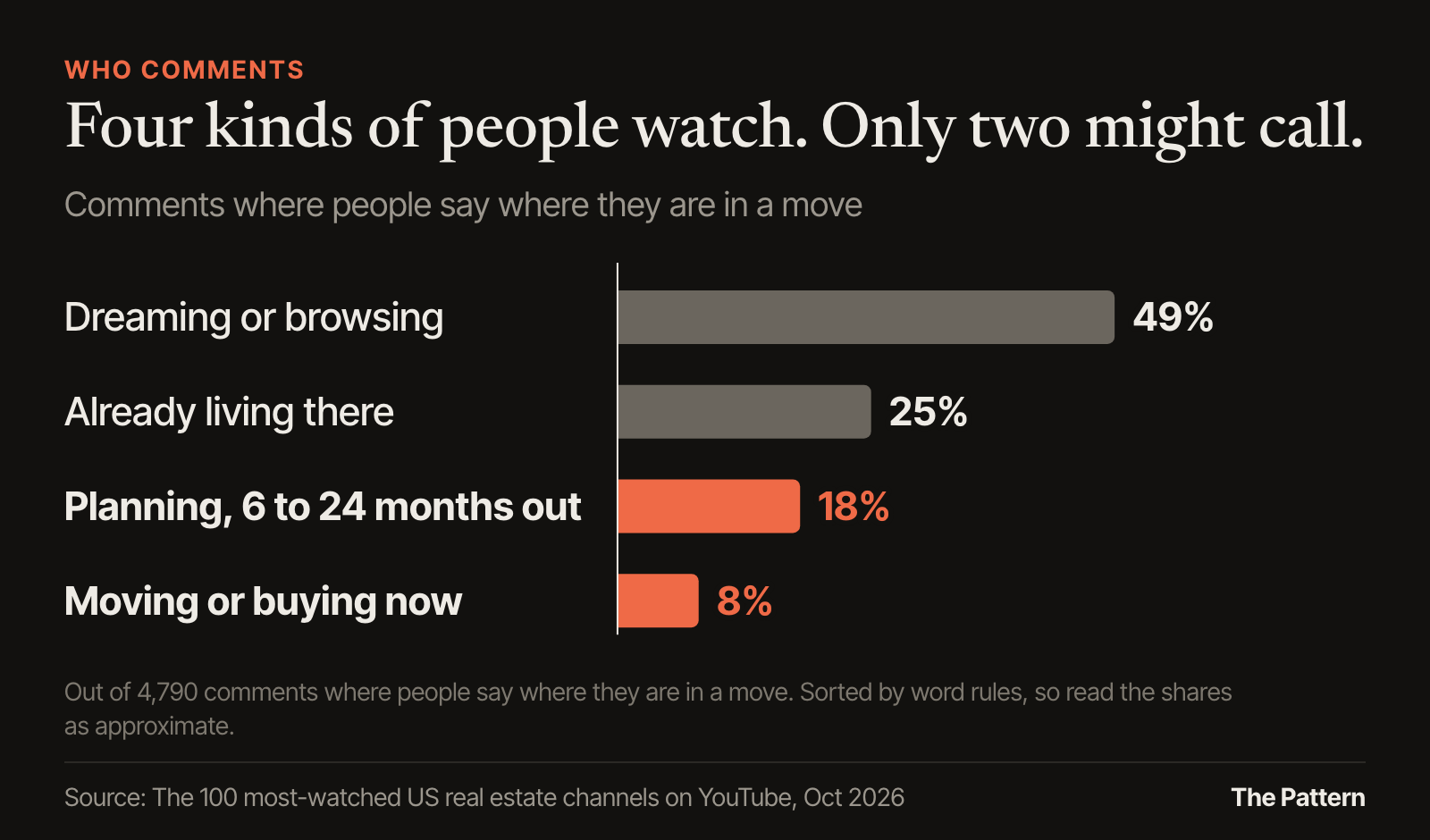
Only the last two might call you. About a quarter of the people who say where they are.
And you don't pick which group you get. Your video does.
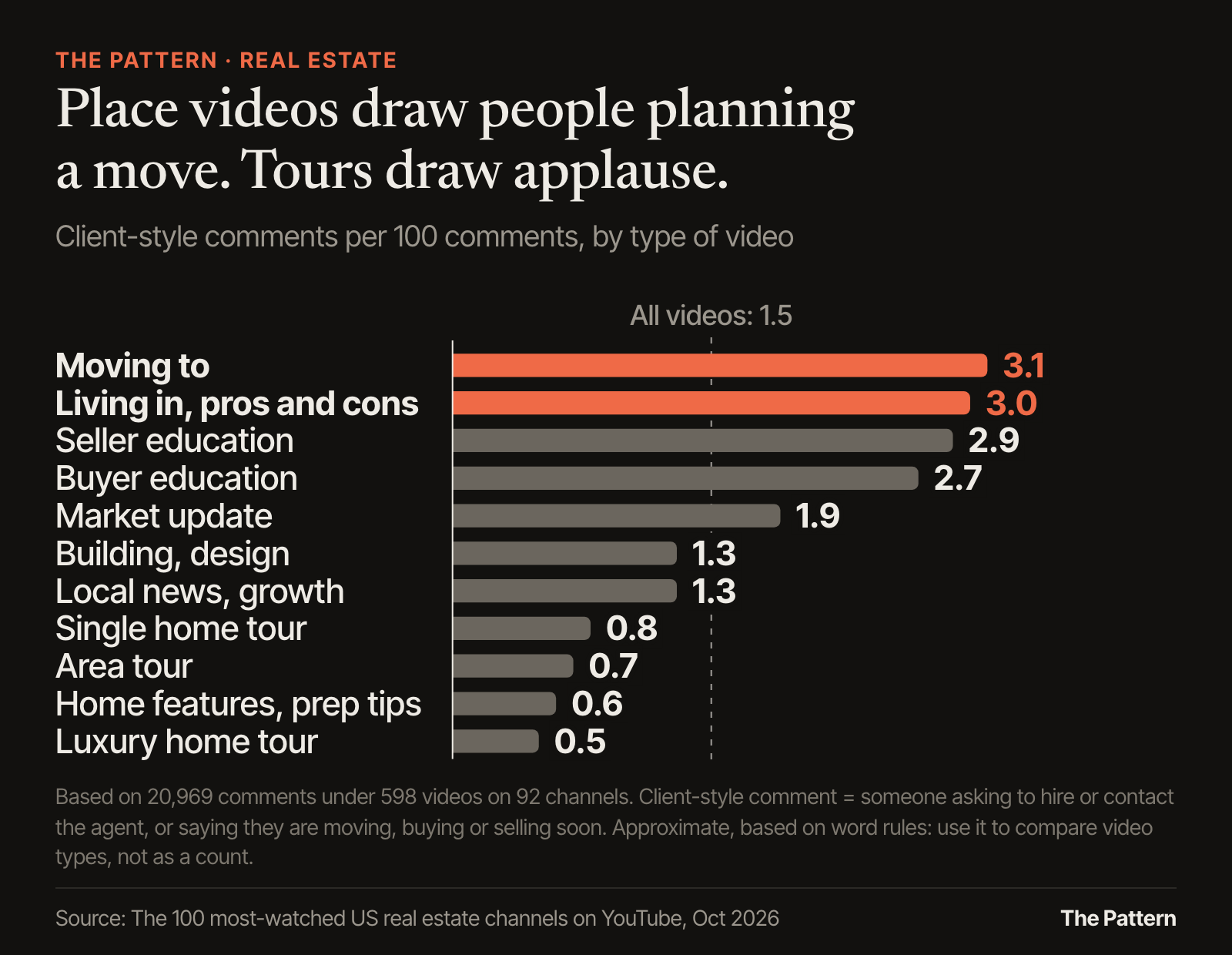
"Moving to" and "living in" videos drew about 6 times more comments that sound like a future client than luxury tours. On luxury tours, 90% of the people who say where they are are dreamers.
Why it happens: a tour is a show
Look at what people ask.
Under luxury tours, the top questions are about the price and the house itself. "How tall are the ceilings?" That's a visitor's question.
Under "moving to" videos, about 1 in 3 questions is about schools, safety, jobs or weather. Then price. Then "what about my area?" One viewer asked: "Does Kingwood have a flooding problem?" That's someone making a list before a move.
My read: a tour is a show, like a cooking show people enjoy with no plan to cook. A place video is research. The viewer is picturing their own life there: the drive to work, the school run, the monthly bill. So they write with a town, a date and a budget.
Here is who comments, by type of video:
Luxury home tour: 90% dreamers. Only 2% moving now.
Single home tour: 72% dreamers.
Area or neighborhood tour: 48% dreamers.
Seller videos: 27% dreamers, and 20% moving or selling now, the highest of any type.
Buyer videos: 21% dreamers, 29% planning.
Market updates: 17% dreamers, 34% planning, the highest of any type.
Below: why views are the wrong scoreboard, why company channels have it worst, the five place videos I'd make instead, a simple shape for each one, how to upgrade a tour you already planned, and what to do this week.
Views are the wrong scoreboard
The obvious fix would be "get more views". It doesn't work that way.
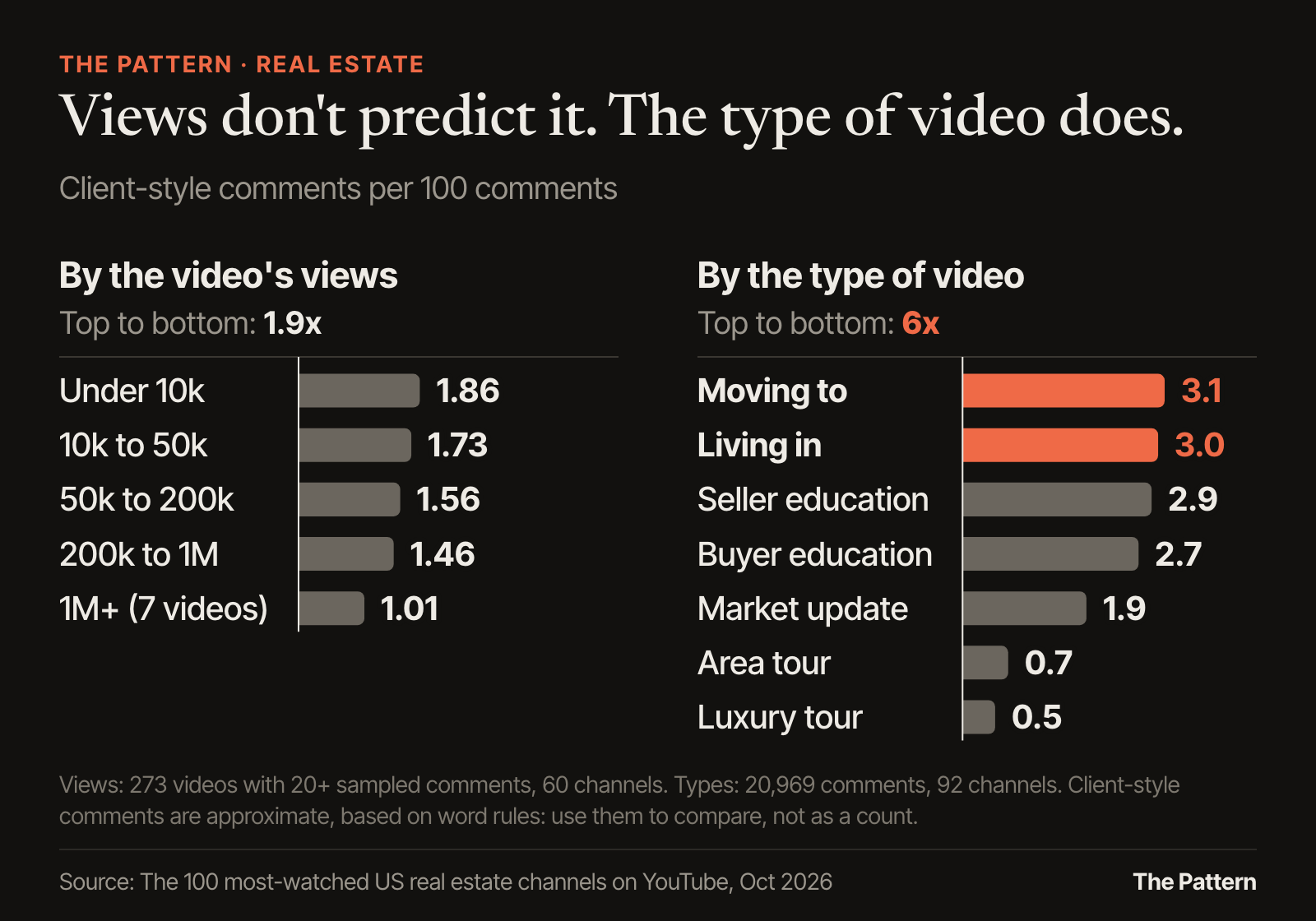
Inside each channel, the bigger half of its videos drew more client-style comments on 20 channels and fewer on 16. A coin toss. The view count barely moves it. The type of video moves it about 6 times.
And tours aren't a mistake. A luxury tour does about as well as a channel's other videos: 31% beat the channel's usual views, 28% fall well below it. It's an average video. It just brings applause, not calls.
So stop judging a video by its views. Count the comments that name a town, a date or a budget.
It's worst on company channels
If you run a brokerage, team or builder channel, this hits harder.
25 company channels: Dreaming: 84%; Planning: 7%; Moving now: 2%; Already live there: 8%
The top 100: Dreaming: 49%; Planning: 18%; Moving now: 8%; Already live there: 25%
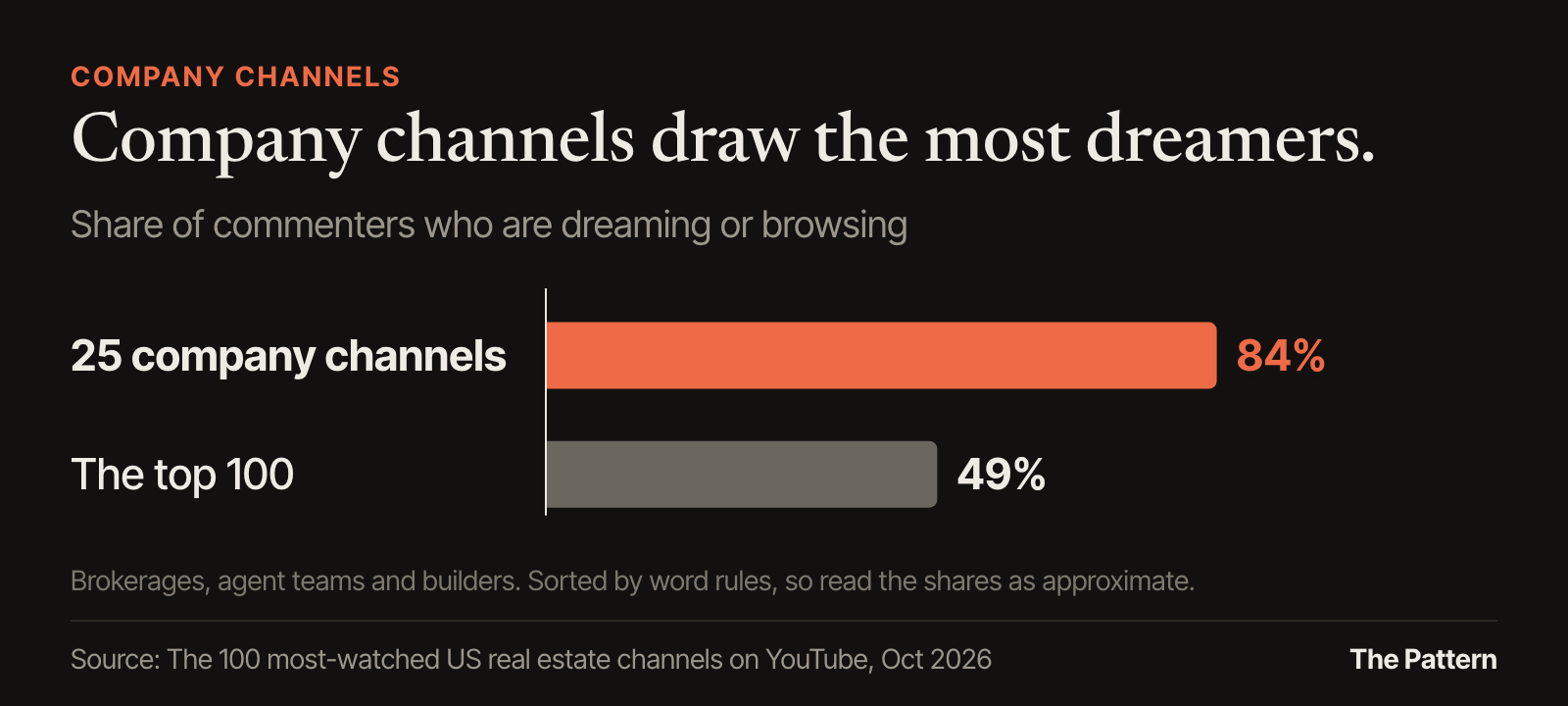
The main reason is the mix. 30% of the company channels' long videos are luxury tours. Across the other top-100 channels it's 15%.
They're also quieter. The typical company channel gets 1.1 comments per 1,000 views, against 2.2 across the top 100. On the typical company channel, 38% of videos get no comments at all. Home tours get the fewest comments of any type: 1.5 per 1,000 views for luxury tours. Videos about living somewhere, cost of living and local news get the most, about 4.4 to 6.4.
The good news: when company channels did make place videos, they worked. "Living in" videos on company channels beat the channel's usual 57% of the time, "moving to" videos 50%. It's a small group (14 videos each, on 4 channels), so treat it as a hint. But it points the same way.
The locals are watching too
One surprise. On "moving to" videos, 45% of the comments where people say where they are come from people who already live there. They watch to see what outsiders are being told.
A few aren't happy. With a narrow word search ("stop moving", "stay away", "we're full") I found 60 comments, on 22 channels, telling newcomers to stay away. One, under the Ocala video above, asked the agent to "do an even better job of discouraging people from moving to my city".
That's only 0.3% of comments. But it tells you something: when you make a video about your town, the people who live there judge it in public. Oversell the place and they'll say so under your video. Be fair, and they become your proof.
What to make instead: five place videos
These are my ideas, built from what viewers ask. Not tested titles.
Moving to [town]: the 5 areas I'd look at first, and who each one fits
Living in [town] with kids: schools, parks and the commute, area by area
[Town A] vs [Town B]: where your budget goes further
Floods, heat and storms in [town]: what I tell buyers before they move
Who should move to [town], and who shouldn't
A simple shape for a place video
The first 30 seconds. Say who it's for and what they'll get: "If you're moving to [town] in the next year, by the end you'll know the 4 areas worth a look and what each costs a month." Show the town, not your logo. On mute, the first shot should still match the title.
3 to 5 sections. One viewer question each: where to live, what it costs, schools and commute, weather and risk, who it's not for. Make the point, show one real example (a street, a home, a number), say what you'd do.
The honest downsides. Not first, and not all at the end. Put the first one in the middle, right after two strong sections, then follow it with your best section.
The end. Close on something good, then one next step: "If you're moving here in the next year, the link at the top of the description books a 15-minute call."
Already have a tour planned? Upgrade it
Make it "tour + bill + neighborhood":
A shorter walk-through of the home.
60 seconds on the neighborhood: minutes to the grocery store, the school, the main road.
30 seconds on the monthly bill: taxes, insurance, HOA.
Who the home suits.
Title it around the place, not the address: "What $450K buys in [suburb], and what you'll pay each month."
Mistakes to avoid
Judging a place video by its views. Count the comments that name a town, a date or a budget instead.
Calling a scenic drive a place video. Scenic area tours drew almost as few client-style comments as luxury tours. People want answers, not only pretty streets.
Skipping the downsides. Viewers ask about floods, crime and schools. Leave those out and their real questions stay open, and the locals will fill them in for you.
Overselling the town. The people who live there are reading.
Pick one person
Put it together and the person you want is clear. Someone planning a move in the next 6 to 24 months. Worried about what it will really cost. Using words like "taxes", "insurance", "HOA" and "next year". Wary of being sold to.
Give that person a name. When you plan a video, ask: "Would this help them decide?"
Do this this week
Sort your last 50 comments: dreamer, local, planning, or moving now. Now you know who your channel is really talking to.
Take the next tour on your list and plan it as a place video instead: the home, the neighborhood, the monthly bill, and who it's for.
Write down one town you serve and the five questions a newcomer would ask about it. That's your next video.
How I did this
I ranked US real estate channels by total views. I started from 1,457 channels I found through 62 YouTube searches and known lists, and kept the ones run by an agent, team, brokerage, builder or relocation business, or that teach buyers and sellers, with an upload in the last 12 months. These are the 100 most-watched among the channels I found, not every channel on YouTube. I also looked at 25 company channels: brokerages, agent teams and builders.
I read 20,581 comments on the topic: the 100 most relevant threads on about 800 videos, which lean toward liked comments. I sorted them with word rules: words that show where someone is in a move (like "closing next week") or a worry (like "insurance"). Those rules miss sarcasm and slang, so treat the shares as "about", and the client-style counts as comparisons between video types, not totals. I also read 300 random comments by hand to check. The farmhouse tour is from November 2024, outside the 12-month window, but its comments are in the sample. I can't see watch time or anyone's private analytics. Only what's public.
More from The Pattern
Two ways to get it done
If you want it done for you. The Green Room: a full YouTube team for your business, picked by me. They plan, film and edit. You show up and go on air. See the Green Room
If you'd rather talk first. Say hi on LinkedIn. I read everything. Connect on LinkedIn